
TL;DR
- Call 911 first, document second — Florida law requires you to report any crash with injuries or property damage over $500.
- Photograph everything: both vehicles, license plates, license and insurance cards, road conditions, skid marks, your helmet, and any visible injuries.
- Get phone numbers from witnesses on the spot — they disappear within minutes once traffic clears.
- Do not admit fault, refuse medical evaluation, or post anything to social media.
- Florida motorcycles are not covered by PIP, so the evidence you collect is the foundation of your entire claim.
- Free consultations available 24/7 with no upfront fees.
If you ride in Hialeah — down West 49th, across the Palmetto, through the Okeechobee Road corridor — your bike has been within a few feet of a distracted driver more times than you'd like to count. When the crash finally happens, what you do in the next 30 minutes can decide whether your case is worth a full settlement or a denial letter.
This guide is the documentation playbook every Hialeah rider should keep in their head — what to capture at the scene, what to avoid, and how Florida's specific motorcycle laws shape the value of your claim.
Why Hialeah Riders Need Bulletproof Scene Documentation
Insurance adjusters do not give motorcycle riders the benefit of the doubt. There's a long-running bias — repeated in claims meetings and jury rooms — that bikers were probably speeding, lane-splitting, or showing off. Hialeah riders see this play out on busy stretches like LeJeune Road, NW 103rd Street, and the SR-826 / Palmetto Expressway interchanges, where it's almost always a car driver who didn't check a blind spot.
Documentation is how you flip that script. Photos and witness statements are evidence the adjuster cannot ignore. They're also the difference between they said, you said and here's what happened, on camera, time-stamped, with three witnesses. For a deeper look at how this prejudice plays out in court, read our breakdown of how bias against motorcycle riders affects your case.
Florida's 2023 tort reform changes also raised the stakes. The state is now a modified comparative negligence jurisdiction — if you're found more than 50% at fault, you recover nothing. Strong scene documentation is what keeps your fault percentage low.
Do These Three Things Before You Touch Your Phone
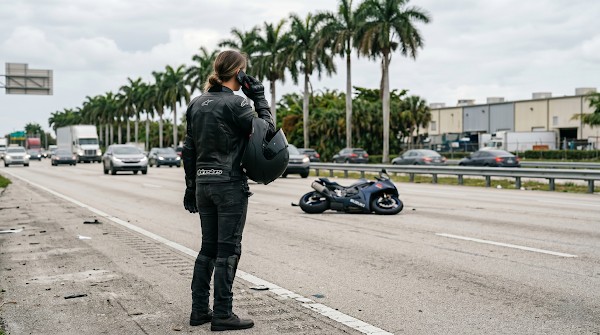
If you're conscious and able to move, do this in order — before you start photographing anything.
Get out of the travel lane. Hialeah's traffic does not slow down for downed riders. If your bike is in a lane, you are at risk of being hit again.
Call 911. Even if you feel okay, even if the other driver is begging you not to. A police report is the single most important document in your case.
Check yourself for injuries calmly. Adrenaline masks pain for 20 to 60 minutes. Do not assume you're uninjured because you can stand up.
Only after those three things should you reach for your phone.
The Scene Documentation Checklist
Work through these nine in order. Don't worry about being polished — you need quantity and accuracy, not artistry. (For a broader post-crash overview that covers what to do beyond just documentation, see our guide on the 7 things every rider must do immediately after a motorcycle crash.)
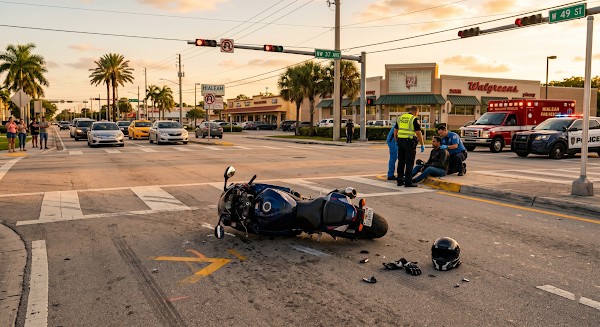
Wide shots of both vehicles in their final resting position. Before anything moves, take 10 to 15 photos of the entire scene from multiple angles. Capture the position of your bike, the other vehicle, the lane markings, and the surrounding intersection. These photos prove how the impact happened.
License plates, license, and insurance card of every driver involved. Photograph the front and back of the other driver's license, both sides of their insurance card, and their license plate. Do this even if they hand you the cards — physical paper gets lost; phone photos do not.
The other driver's verbal statement, in their own words. Open the voice memo app on your phone and ask, "Can you tell me what you saw?" Most drivers will admit something useful in the first 30 seconds — I didn't see you, I was looking at my GPS, the sun was in my eyes. Record it. Florida is a one-party consent state, meaning you can legally record a conversation you are part of.
Witnesses — names and phone numbers. This is the one most riders skip. People who say "I saw the whole thing" are gone within five minutes of traffic moving. Walk up to anyone who slowed down or pulled over and ask for their name, phone number, and a one-sentence description of what they saw. Take a photo of their license plate too if they're in a car.
Skid marks, debris field, and road conditions. Photograph any skid marks (yours and theirs), broken glass, fluid leaks, scattered debris, and the surface of the road itself. Pothole? Loose gravel? Standing water? All of it matters.
Traffic signs, signals, and lines of sight. Photograph every stop sign, yield sign, and traffic light at the intersection — including their state at the time (green, red, yellow). Capture obstructed views: a parked truck, an overgrown hedge, a delivery van blocking a sightline. Hialeah has dense commercial blocks where blocked sightlines are a common cause of crashes.
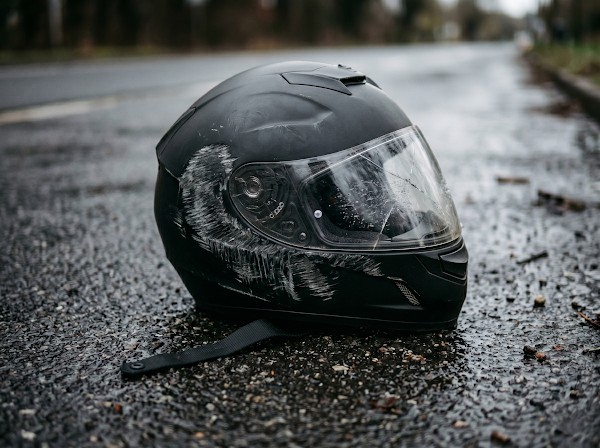
Your helmet, jacket, gloves, and boots. Damage to your gear is direct evidence of impact severity. Lay your helmet on the ground next to your bike and photograph the side that took the hit. Do not throw any of it away — that helmet may be worth thousands in damages.
Visible injuries — even the small ones. Road rash, bruising, cuts, swelling. Photograph everything you can see, with timestamps. Bruises will look much worse in 24 to 48 hours, and you'll want the "before" picture.
Nearby cameras and businesses. Look around. Is there a gas station, a bodega, a restaurant, a bus stop, or a residential Ring camera with a view of the intersection? Note the business name and address. Surveillance footage often gets overwritten in 48 to 72 hours, so the sooner your attorney requests it, the better.
Five Things You Should Not Do at the Scene
Do not admit fault. Even "I'm sorry" can be twisted into an admission. Stick to facts.
Do not refuse medical evaluation. If EMS offers to check you, let them. The medical record creates a contemporaneous link between the crash and any injury that surfaces later.
Do not negotiate with the other driver. No cash exchanges, no "let's keep insurance out of it." Riders who agree to skip the police report regret it almost every single time.
Do not sign anything from the other driver's insurance company. Their adjuster may call within hours. Politely decline to give a recorded statement until you've spoken with an attorney.
Do not post on social media. A single photo of you smiling at the hospital can be used to argue you weren't really hurt. Stay offline.

Florida Laws Every Hialeah Motorcycle Rider Should Know
A few legal realities make motorcycle claims in Florida fundamentally different from car claims. For a broader look at the rules every Hialeah driver operates under, see our companion article on Hialeah car accident laws.
Motorcycles are exempt from PIP. Florida's no-fault Personal Injury Protection coverage does not apply to motorcycles. That means you cannot rely on your own auto policy to cover the first $10,000 in medical bills the way a car driver can. Your medical recovery typically depends on the at-fault driver's bodily injury liability coverage, your own health insurance, or any optional medical payments coverage you purchased.
The statute of limitations is now two years. Following Florida's 2023 tort reform, you have two years from the date of the crash to file a personal injury lawsuit. Waiting destroys cases.
Helmet law is conditional. Florida riders 21 and over with at least $10,000 in medical insurance coverage may legally ride without a helmet. Choosing not to wear one can, however, be used to argue comparative negligence on head-injury claims.
Leaving the scene is a felony. Under Florida Statute §316.027, leaving the scene of a crash involving injury is a third-degree felony — at minimum. Stay until law enforcement releases you.
This article is general legal information, not legal advice. Every case is different, and you should speak directly with a Florida-licensed personal injury attorney about your specific situation.
What Happens After You Leave the Scene
Once police clear you to leave, the work is not over. The next 24 hours shape the medical and evidentiary record your case will rest on.
Go directly to a hospital or urgent care. Palmetto General, Hialeah Hospital, and Jackson West are all minutes from most Hialeah crash sites. A 24-hour gap between the crash and your medical visit gives the insurance company room to argue you weren't really hurt.
Save your gear in a bag. Do not wash, repair, or discard anything — helmet, jacket, gloves, boots, even the damaged bike. Each item is potential evidence.
Write down everything you remember while it's fresh. Speed, direction, what the other driver did, weather, traffic, anything the driver said. Use a voice memo if writing is difficult.
Request the police crash report. Within 7 to 10 days, pull the report from the Hialeah Police Department or the Florida Crash Portal.
Call a motorcycle accident attorney before calling the insurance company. This single decision determines how much leverage you walk into negotiations with.
Frequently Asked Questions
What if I left the scene before documenting anything? You can still build a case, but it gets harder. Get the police report number, contact any witnesses you can identify, request nearby surveillance footage immediately, and photograph your injuries and gear as soon as you can. The sooner you call an attorney, the more recoverable evidence you have.
Do I have to call the police after every motorcycle accident in Hialeah? Florida Statute §316.066 requires a written report for any crash involving injury, death, or property damage of $500 or more. With a motorcycle, that threshold is almost always crossed — call 911.
What if the other driver doesn't have insurance? You may still recover under your own uninsured/underinsured motorist (UM/UIM) coverage if you carry it. This is one of the most important coverages a motorcycle rider can buy in Florida.
Should I talk to the other driver's insurance company? No — at least not before speaking with an attorney. Their adjuster's job is to limit what they pay. Any recorded statement you give can and will be used against you.
How long do I have to file a motorcycle accident claim in Florida? Two years from the date of the crash, under Florida's 2023 tort reform. Some specific situations (like wrongful death) have separate timelines.
Can I still get compensation if I wasn't wearing a helmet? Possibly, yes — Florida law allows riders 21 and over with $10,000 in medical coverage to ride without a helmet. The lack of a helmet may be used to argue comparative negligence on head-injury damages, but it does not bar recovery for the rest of your injuries.
How much does it cost to hire a motorcycle accident lawyer at JDLE? Nothing upfront. JDLE Lawyers works on contingency — no win, no fee. You only pay if we recover compensation for you.
Talk to a Hialeah Motorcycle Accident Attorney
If you've been hit while riding in Hialeah, the documentation you collect at the scene is only the start. The real fight begins when the insurance company calls. Our Miami motorcycle accident lawyers have been representing injured riders across Miami-Dade since 2006 — bilingual, contingency-based, and built to fight for the people insurance companies expect to roll over.
Free, confidential consultations are available 24 hours a day, 7 days a week. Call JDLE Lawyers right now at (305) 363-7855 for a free consultation. No win, no fee.
Related articles
- Kissimmee Personal Injury Lawyer
- Compensation for Brain Injury Victims in Miami: Legal Pathways
- Florida Wrongful Death Lawyer
- Hialeah Car Accident Laws: Understanding Your Legal Rights and Responsibilities
- 5 Things You Should Do After a Motorcycle Accident in Doral (Most People Forget #3)
- Best Doral Motorcycle Accident Lawyer: How to Choose the Right Attorney
- Ensuring Safe Journeys: A Comprehensive Guide to Mitigate Motorcycle Accidents in Doral
- Filing a Personal Injury Claim in Miami Lakes? Start Here