
TL;DR

- Roughly one in five Florida drivers carries no liability insurance, according to state data.
- Florida doesn't require Bodily Injury Liability coverage, so a driver can be fully legal on the road while carrying nothing that pays for your injuries if they cause a crash.
- Uninsured Motorist (UM) coverage on your own policy is often the only realistic way to recover full compensation when the at-fault driver is uninsured.
- Filing a UM claim means your own insurance company becomes the party you're negotiating against, which changes the dynamic of the claim.
- Florida law allows you to reject UM coverage in writing, but doing so removes a safety net a large share of drivers end up needing.
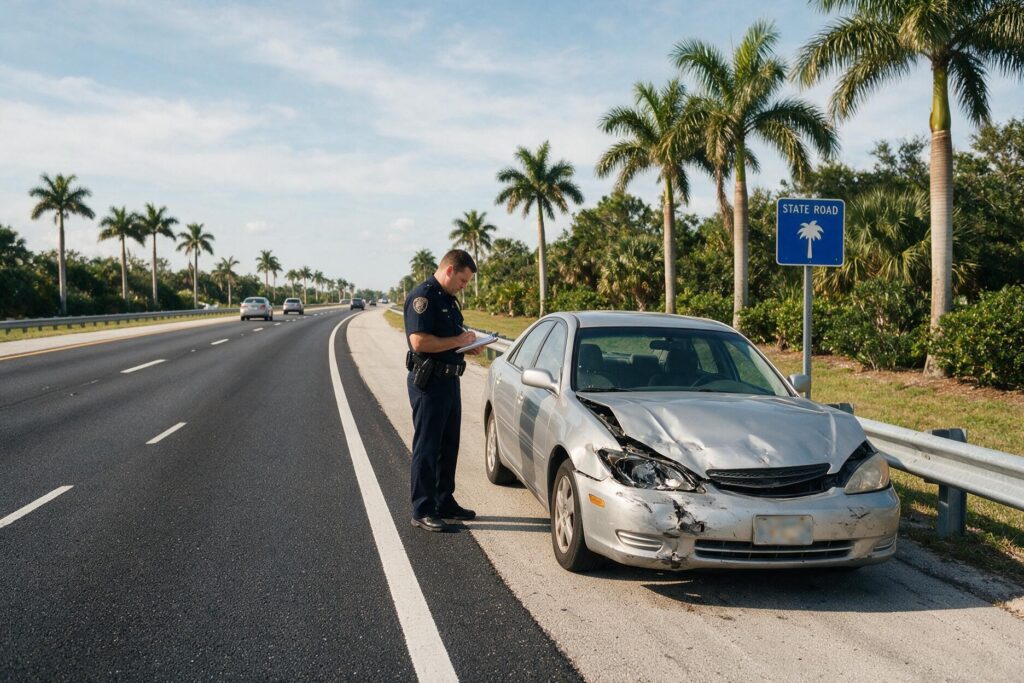
Getting hit by a driver who turns out to have no insurance is one of the more frustrating outcomes in Florida, precisely because it's so common here. If you've just learned the at-fault driver in your accident is uninsured, here's what that actually means for your claim and where your compensation is realistically going to come from.
Why This Happens So Often in Florida
Florida's insurance requirements are narrower than most states realize. Every registered vehicle must carry Personal Injury Protection (PIP) and Property Damage Liability (PDL) coverage, but Bodily Injury Liability — the coverage that actually pays for someone else's injuries when you're at fault — isn't required at all. That gap, combined with high premiums statewide, contributes to one of the highest uninsured-driver rates in the country. According to FLHSMV's own uninsured motorist data, the statewide uninsured rate has consistently run in the high teens to low twenties as a percentage of drivers in recent years.
That means a driver can run a red light, total your car, and cause a serious injury, all while being completely within Florida's minimum legal requirements to register a vehicle. Your PIP covers a portion of your own medical bills regardless of fault, but Florida Statute §627.7407 caps PIP at $10,000 — nowhere near enough for a serious injury, and it doesn't compensate you for pain and suffering at all.
Where Your Compensation Actually Comes From
When the at-fault driver has no Bodily Injury Liability coverage, there typically isn't a defendant's insurance policy to pursue for the damages PIP doesn't cover. That's where Uninsured Motorist (UM) coverage on your own auto policy becomes critical. Under Florida Statute §627.727, insurers must offer UM coverage on every policy issued in Florida, specifically to protect you when the at-fault driver is uninsured or when they have insurance but not enough to cover your full damages (known as underinsured motorist coverage, or UIM).
If you carry UM/UIM coverage, your own insurer effectively stands in for the at-fault driver's missing or insufficient coverage. You can recover for medical expenses beyond PIP, lost wages, and pain and suffering, up to your policy's UM limits. Fault still matters in these claims the same way it would in any other auto accident — if the insurer argues you share some responsibility for the crash, Florida's comparative negligence rule can still reduce what you recover, even from your own UM policy.
The Uncomfortable Part: Your Insurer Is Now the Other Side
A UM claim creates an unusual dynamic. You're not negotiating with a stranger's insurance company — you're negotiating with the company you've paid premiums to for years, and they know it. UM claims are still adversarial in practice, even though it might not feel that way at first.
Common friction points in a UM claim include:
- Disputes over how much your injuries are actually worth, the same way any insurer disputes valuation
- Requests for an Examination Under Oath (EUO), a formal recorded interview UM policies often require
- Delays in confirming the other driver's lack of coverage, even when the crash report already states it
- Arguments that some of your injuries pre-existed the crash or aren't as severe as claimed
None of this means your own insurer is acting in bad faith by default, but it does mean you shouldn't treat a UM claim as a formality just because you're "on the same team."
Can You Reject UM Coverage in Florida?
Yes. Florida law allows policyholders to reject UM coverage in writing, and many drivers do so without fully understanding what they're giving up, often to lower their premium slightly. Given that a meaningful share of Florida drivers on the road carry no liability insurance at all, rejecting UM coverage means betting that you'll never be seriously hurt by one of them. If you're unsure whether your policy includes UM coverage, checking your declarations page before you need it is far easier than finding out after a crash.
Stacking Coverage When You Have More Than One Policy
Some Florida drivers have UM coverage on more than one vehicle, either because they insure multiple cars on the same policy or because they're a passenger in someone else's vehicle at the time of the crash. Whether you can combine, or "stack," those coverage limits depends entirely on how your policy is written. Florida insurers are required to offer stacked UM coverage, but many policyholders choose non-stacked coverage for a lower premium without realizing the tradeoff.
If your policy is stacked, the UM limits on each vehicle you insure can potentially be added together, which meaningfully increases the total compensation available after a serious crash. If it's non-stacked, you're limited to the UM amount tied to the specific vehicle involved in the accident, even if you pay for UM coverage on three other cars in your household. This distinction rarely gets attention until after a crash happens, at which point it's too late to change your policy for that claim, which is exactly why it's worth confirming now rather than assuming your coverage works one way when it actually works the other.
What To Do If You're Hit by an Uninsured Driver
- Get the police report and confirm the "no insurance" finding — this becomes central evidence in your UM claim
- Check your own policy for UM/UIM coverage before assuming you have no path to compensation
- Report the claim to your insurer promptly, since most policies have notice requirements
- Be cautious in any recorded statement or EUO, since these are formal, sworn interviews even when your own insurer is conducting them
- Document your injuries and losses as thoroughly as you would in any other claim — the fact that you're dealing with your own insurer doesn't lower the evidentiary bar
If you were hurt in a Florida car accident and learned the other driver had no coverage, understanding your UM options early can prevent your own insurer from resolving the claim faster and cheaper than it should.
Frequently Asked Questions
What's the difference between uninsured and underinsured motorist coverage?
Uninsured motorist (UM) coverage applies when the at-fault driver has no liability insurance at all. Underinsured motorist (UIM) coverage applies when they have insurance, but the limits are too low to cover your full damages.
Do I have to sue the uninsured driver directly?
Not necessarily. Most UM claims are resolved directly with your own insurer without a separate lawsuit against the at-fault driver, though pursuing the driver personally sometimes remains an option if they have assets worth pursuing.
Will filing a UM claim raise my insurance rates?
Florida law generally prohibits insurers from raising your rates or non-renewing your policy solely because you filed a UM claim for an accident that wasn't your fault, though you should confirm your specific policy terms.
What if the at-fault driver fled the scene and was never identified?
Hit-and-run accidents where the driver is never identified are typically treated as uninsured motorist claims, since there's no insurance policy to pursue against an unknown driver.
How much UM coverage should I actually carry?
There's no single right answer, but many attorneys recommend carrying UM limits that match your Bodily Injury Liability limits, since a mismatch leaves a gap in your own protection.
Can my own insurance company deny my UM claim?
Yes, insurers can dispute UM claims just as they would any other claim — disputing fault, injury severity, or valuation. A denial isn't necessarily final, and disputed UM claims can still be pursued through negotiation or litigation.
The Bottom Line
Being hit by an uninsured driver doesn't mean you're out of options, but it does mean the path to compensation runs through your own insurance policy instead of theirs, and that path has its own friction points worth understanding upfront. If you're dealing with a UM claim, or you're not sure what coverage you actually carry, DLE Lawyers offers a free consultation to review your policy and your options.